Management system guidance
8.1 Operational Planning and Control
ISO Navigator Pro™ is a free tool that provides practical, expert guidance for businesses wishing to interpret and better implement the requirements of ISO 9001:2026, ISO 14001:2026 and ISO 45001:2018.
Our range of ISO templates cover the requirements of ISO 9001:2026, ISO 14001:2026 and ISO 45001:2018, and offer an easy way to implement your next management system.
8.1.3 Management of change
Change brings risk, whereas managing change reduces it. Clause 8.1.3 requires your organization to establish a process (or processes) for implementing and controlling planned changes, both temporary and permanent, that affect OH&S performance. The aim is to keep new hazards and OH&S risks from entering the workplace unnoticed as things change.
What changes must be covered?
ISO 45001:2018 lists the types of change the process must address:
- New or changed products, services and processes, including changes to:
- workplace locations and their surroundings;
- how work is organized;
- working conditions;
- equipment;
- the workforce (numbers, skills, contract or agency labour);
- Changes to legal requirements and other requirements;
- Changes in knowledge or information about hazards and OH&S risks;
- Developments in knowledge and technology.
The organization must also review the consequences of unintended changes – for example a key competent person leaving suddenly, an equipment failure that forces a work-around, or a supplier changing a material formulation without notice – and take action to mitigate any adverse effects as necessary. ISO 45001 notes that changes can result in both risks and opportunities.
A practical management of change process
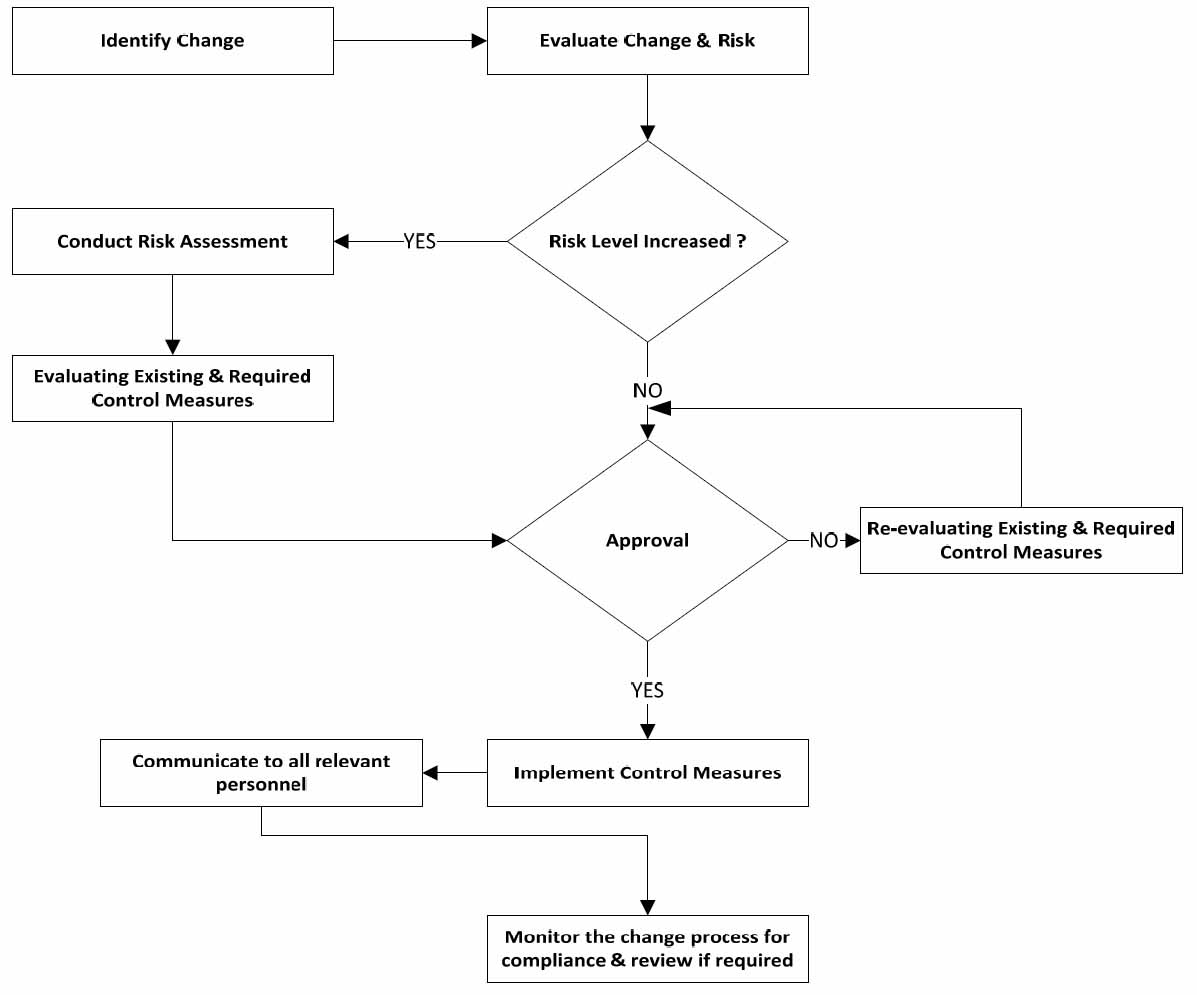
Whether it is new equipment, a revised maintenance procedure, a temporary work-around, a reorganization or a move to new premises, a simple, consistent process works best:
- Identify – make it easy for anyone to raise a proposed change and define what triggers the process;
- Assess – identify the hazards the change could introduce or remove and assess the OH&S risks and opportunities (see 6.1.2), using a method suited to the scale of change, such as a design review, a task risk assessment or a HAZOP;
- Consult – involve the workers affected and their representatives before the change is made;
- Plan controls – apply the hierarchy of controls (see 8.1.2) and update procedures, training, legal compliance arrangements and emergency plans;
- Approve – authorize the change at a level matching its risk;
- Implement and communicate – brief everyone affected, including contractors;
- Review – after implementation, confirm the controls are working and, for temporary changes, that the original arrangements were restored on time.
People and organizational change
Organizational changes – restructuring, staff reductions, new shift patterns or new managers – are easily overlooked but can have significant effects on health and safety. Concerns about workload, job security and access to training can raise stress and erode safety culture. The degree to which workers feel involved in the change and understand their role will strongly influence how well it succeeds. Clause 5.4 requires consultation of non-managerial workers on the changes that could affect OH&S, so build consultation into your change process rather than announcing decisions after they are made.
Links to other clauses
- The need to manage a change may be an outcome of planning action (see 6.1.4);
- Changes in legal requirements and other requirements are identified through 6.1.3;
- Changes may need new competence (see 7.2) and communication (see 7.4);
- Procurement of new equipment or services should be checked against OH&S criteria (see 8.1.4);
- Changes relevant to the OH&S management system are considered in 9.3 management review.
You should seek and record evidence that a management of change process has been established; that planned temporary and permanent changes are assessed for hazards and OH&S risks before they are implemented; that affected workers were consulted; that controls, procedures and training were updated; that temporary changes are tracked and closed; and that the consequences of unintended changes are reviewed and mitigating action taken where necessary.
More information on PDCA
Planning
Context
Planning
Support
Doing
Support
Operations
Checking
Monitoring, measurement, analysis and evaluation
Acting
Improvement
Want to know more?
- Read our customer's feedback
- Client list - who's using our templates?
- How the templates are formatted and download examples
- Why we use turtle diagrams and process maps
- What's the difference between a process and a procedure?
- About documented information
SSL certification
A certificate guarantees the information your internet browser is receiving now originates from the expected domain - https://www.iso9001help.co.uk. It guarantees that when you make a purchase, sensitive data is encrypted and sent to the right place, and not to a malicious third-party.
Free PDCA guidance
ISO Navigator™ is our FREE online training tool that shows you how to apply the principles of PDCA to your operations. We also offer many helpful templates that get you on the road to documenting your management system, please visit the download page.