Environmental aspects procedure
ISO management system procedures and forms
Introduction and purpose

The purpose of the environmental aspects procedure is to outline your organization’s methodology for identifying environmental aspects that relate to your operations and product life cycle and for the subsequent determination of the significance of related impacts that may have actual or potentially significant impacts on the environment.
Using the environmental aspect identification register, the EMS Manager and Process Owners should identify all raw materials, chemicals, and utilities that are used as process inputs and all outputs, such as products, services, and by-products that are associated with your operations while giving due consideration to normal, abnormal operating conditions, startup, shutdown, and foreseeable emergencies.
Application and scope
The environmental aspects procedure has been developed to assist in meeting the requirements of Clause 6.1.2 of ISO 14001:2026 - Environmental aspects. The 2026 edition asks organizations to take account of normal and abnormal conditions, changes such as planned or new developments, and potential emergency situations, with significant aspects then informing risks and opportunities (6.1.4).
All business activities should be assessed to ensure that any changes to processes and operations do not result in significant environmental aspects. Details are recorded in the aspect identification register for consideration when your organization does not have a degree of control or influence over the environmental aspect.
The environmental aspect procedure includes four essential form templates referenced from the procedure, supplied in .docx and .xlsx formats that can be retained as hard or soft copies.
Aspect identification register
Within the aspect identification register, an assessment of the potential environmental impact of each aspect should be recorded. A scoring system within the register can be used to help identify the significance of each environmental aspect. The scoring process also allows consideration of normal, abnormal, and emergency operating conditions.
Environmental aspects should be identified by considering all business activities to ensure that all impacts from your processes, activities, and operations are identified, captured, and assessed. Identify all materials, chemicals, and utilities that are used as process inputs, including all outputs such as products, services, and by-products.
All environmental aspects and impacts rated as 'significant' must be controlled through operational control procedures. Those environmental aspects must also be considered when implementing and maintaining your organization's management system.
Their ongoing management and mitigation must be deployed within the environmental management system via setting related objectives and targets to reduce the impact, implementing procedures and training programmes, and by undertaking internal audits.
Opportunity evaluation
Organizations can take advantage of new opportunities by building on current strengths, anticipating future trends, introducing new technology, developing new products or services, capturing and disseminating lessons learned, sharing and promoting good practices, opening new markets, and attracting new customers.
SWOT analysis
A SWOT analysis can uncover areas of the business that are holding you back or that your competitors could exploit if you do not protect yourself. Many criteria will apply to more than one quadrant in the matrix. Identify the criteria appropriate to your own situation. The relevance of internal climate change considerations should be captured in this document.
PESTLE analysis
A workshop approach is often best when undertaking a PESTLE analysis. Organizations should include climate change as an external issue in their PESTLE analysis and make a statement on its relevance. This should be discussed during management review meetings and recorded in the review meeting minutes.
The relevance of climate change issues will vary greatly depending on the size and sector of your organization, the products and services provided, its position in the supply chain, its geography, and the scope of your organization’s management system.
Quick to download and easy to implement!
Prepared using MS Office, the environmental aspects procedure and forms are fully editable. Easily amend the headers, footers, text, turtle diagrams, process maps, and layout style to suit your business's formatting requirements.
| Single-standard procedure and forms | ISO 9001 QMS |
ISO 14001 EMS |
ISO 45001 OHS |
|---|---|---|---|
| Individual, single-standard environmental aspects procedure template and turtle diagram, with 4 forms: | |||
| » Aspect Identification Register [.xlsx] | ✗ | ✓ | ✗ |
| » Opportunity Analysis Form [.docx] | ✗ | ✓ | ✗ |
| » SWOT Analysis Form [.docx] | ✗ | ✓ | ✗ |
| » PESTLE Analysis Form [.docx] | ✗ | ✓ | ✗ |
| » Updated for the ISO 14001:2026 revision | ✗ | ✓ | ✗ |
| Shop with confidence! Secure payment and fast download direct from our SSL server | |||
| » Unlimited email support | ✗ | ✓ | ✗ |
| » 100% Compliance Guarantee | ✗ | ✓ | ✗ |
| » 100% Money-back Guarantee | ✗ | ✓ | ✗ |
Click the 'Buy Now' button, the order page will load, select your payment method. The template's download link will become available after completing purchase. |
£0.00 ~ €0.00 EUR $0.00 USD $0.00 CAD $0.00 AUD  |
£14.99 ~ €17.30 EUR $20.60 USD $27.85 CAD $29.37 AUD |
£0.00 ~ €0.00 EUR $0.00 USD $0.00 CAD $0.00 AUD |
When you're ready to order, click the procedure template's 'Buy Now' button to open the order page. The template's download link will become available automatically after completing payment
Payment methods
International customers are welcome to pay using your PayPal account, or with your credit or debit card, in your currency. PayPal will automatically convert your payment, we can accept payments from buyers from 190 different countries!
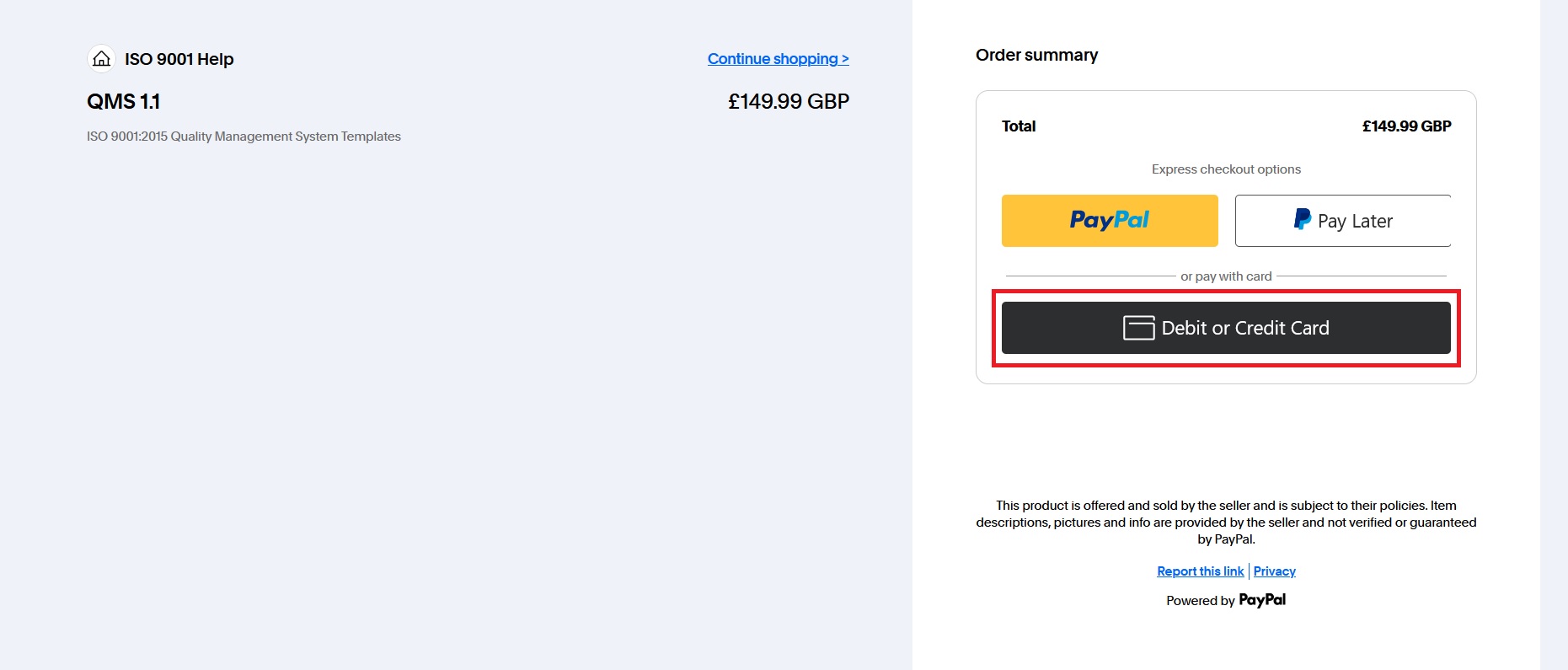
Debit or Credit Card
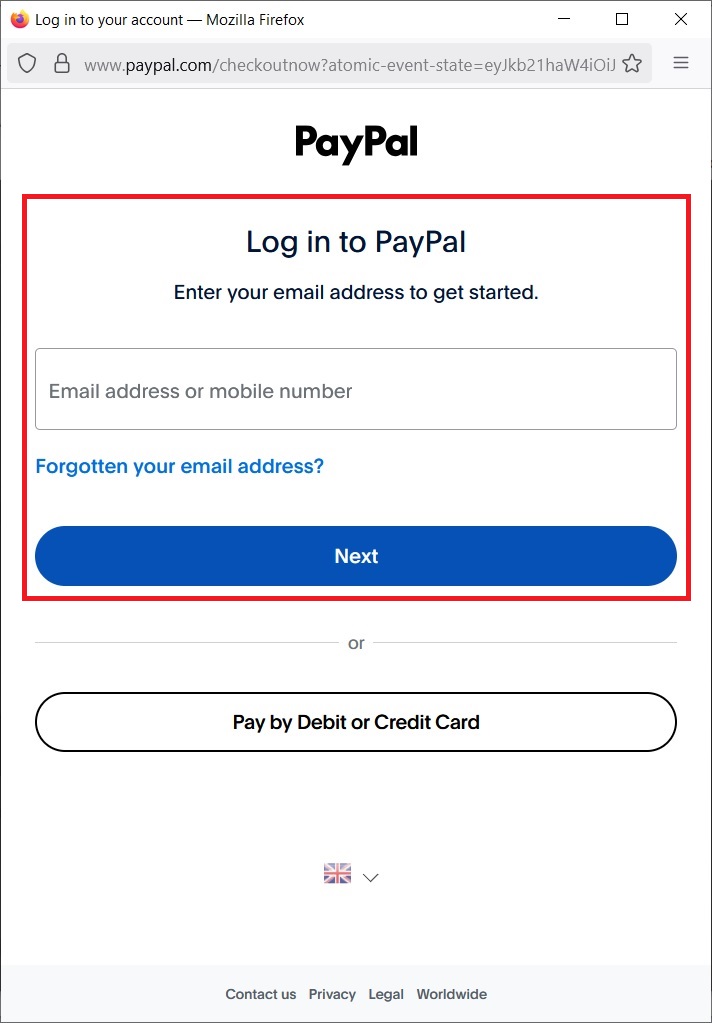
 PayPal Account
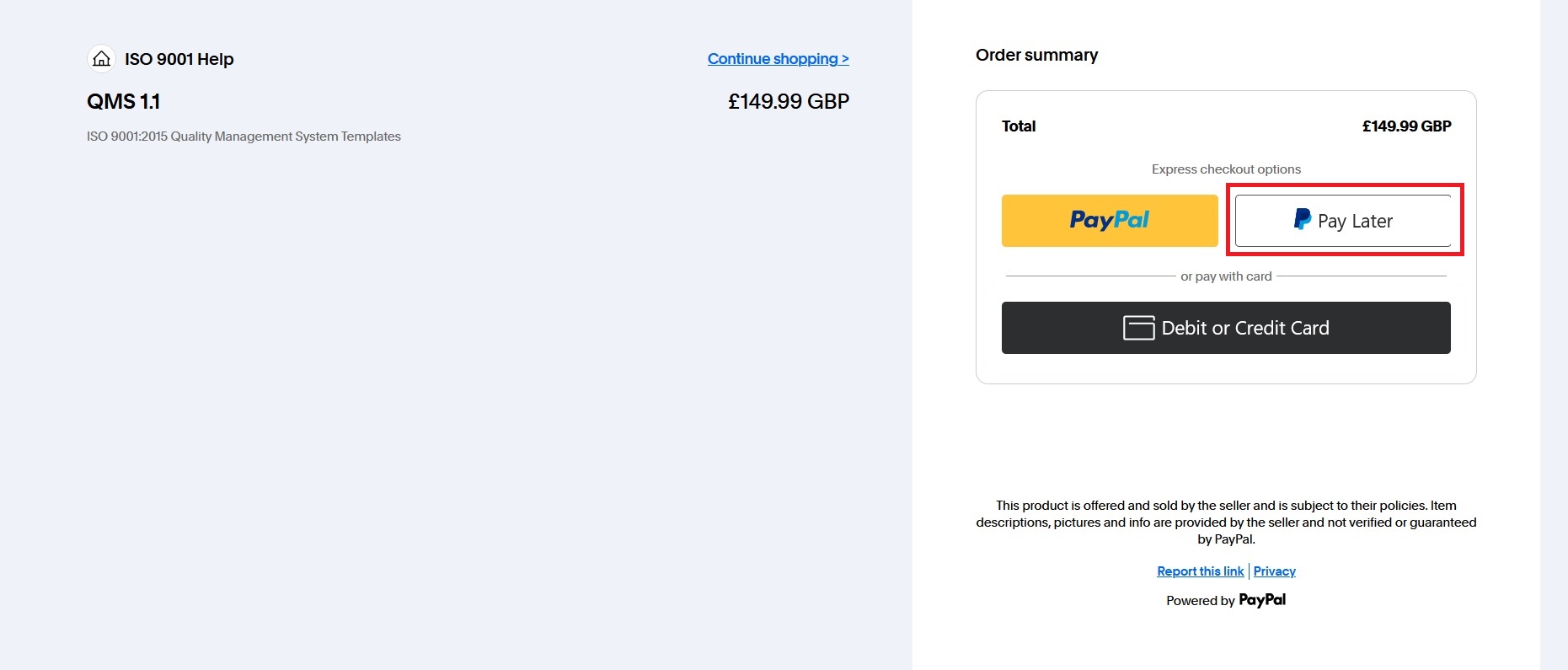
 PayPal Pay Later
 Purchase Order
Trusted by businesses worldwide
To experience real, long-term benefits, our ISO management system templates have continually evolved and supported our client's transition from different revisions of ISO 9001, including the 2000, 2008 and 2015 revisions, and presently; the 2026 revision, which incorporates the 2024 climate change amendments.
Since then, we have helped over 50,000 small businesses and globally recognized brands show strong governance by implementing their own ISO management system, we can help you too.
Certification Bodies such as BSI and UKAS, as well as independent Consultants and External Auditors, have commented upon the high-level of detail and excellent presentation standard. 'A practical guide to producing your own quality management system'. Cranfield University, UK.
Join thousands of small businesses and globally recognized brands who trust our management system resources, solutions, and tools to help them navigate complex compliance challenges, and achieve their certification goals in diverse business sectors ranging from:
✓ |
Consultancies |
✓ |
Aviation Services |
✓ |
Digital Media & IT |
✓ |
County, City & State Councils |
✓ |
Engineering |
✓ |
Retail & Distribution |
✓ |
Manufacturing |
✓ |
Printing & Publishing |
✓ |
Construction & Subcontractors |
✓ |
Colleges, Universities & Students |
✓ |
Oil & Gas |
✓ |
Marine & Shipping |
✓ |
Private & State Healthcare |
✓ |
Government Agencies |
✓ |
Pharmaceuticals |
✓ |
Finance & Insurance |
✓ |
Renewable Energy |
✓ |
Biotechnology |
Want to know more?
- Read our customer's feedback
- Client list - who's using our templates?
- How the templates are formatted and download examples
- Why we use turtle diagrams and process maps
- What's the difference between a process and a procedure?
- About documented information
SSL certification
A certificate guarantees the information your internet browser is receiving now originates from the expected domain - https://www.iso9001help.co.uk. It guarantees that when you make a purchase, sensitive data is encrypted and sent to the right place, and not to a malicious third-party.
Free PDCA guidance
ISO Navigator™ is our FREE online training tool that shows you how to apply the principles of PDCA to your operations. We also offer many helpful templates that get you on the road to documenting your management system, please visit the download page.